Community
Share your thoughts, experiences or questions and participate in discussions over our favorite topic : SCUBA diving!
FFESSM N2 certification: going yo-yo
by Pascal on August 04, 2011

The French FFESSM N2 (equivalent to CMAS 2 Stars or PADI AOW) diver certification is not just about going deeper. It's definitely about autonomy. It allows the certified diver to go up to 40m accompanied by a N4 diver, but it also allows him to dive in autonomy with another N2 diver up to 20m.I just passed the certification (already waited too long), and really the whole point of the whole training was about getting safely your buddy back to safety, i.e. on the surface. And I can assure you that the instructors from Easy Dive on the French Riviera really took this responsibility seriously. We had to bring up several times instructors who had "fainted" and were falling head first into the...
Fighting moisture in your underwater housing
by Ksso on May 05, 2011
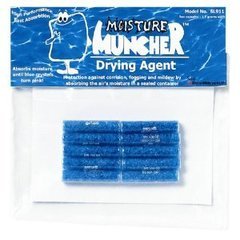
If you're doing some underwater photography, you know how painful moisture can be. A few drops of waters in your housing, pressure, and *bam*, you can't take pictures anymore.That's why god (well science rather) gave us silica gel.Those funny tiny white bags actually are supposed to capture moisture and keep the inside of your housing dry, but beware, those do not last forever - when they captured all the water in the air they stop working, and drying them out is a pain (and can be just impossible in some cases). Even worse, it's almost impossible to tell the state of your silica bags, they may be useless already but you have no way to tell...Now here's my little secret : I use those...
Big Women Really Are Fun
by Ksso on March 27, 2011

Before getting in the water you need to perform a full body check with your dive buddy. This sentence "Big Women Really Are Fun" is my way of remembering how to do it properly without forgetting anything :
B(ig) - BCD : check out your buddy's BCD , how it attaches, how it works (especially in case if you need to grab him and get him to the surface safely, you'll need to be able to controle your buddy's buoyancy
W(omen) - Weight : check the weight belt, right hand release, no nested straps
R(eally) - Regulators : check the position of the safety additional regulator and ensure that nothing blocks or slows access to it ...
The underwater photographer
by Ksso on March 22, 2011

I love to take underwater pictures, but let's face it, although technology got more affordable, it's awfully complicated to take decent underwater pictures. I recently got my hands on that book by Martin Edge, the Underwater Photographer, which really did help me understand better the whereabouts of underwater photography, including why it's so hard. Here are a few quotes that I'll try to keep in mind from now on :(...) the density of water is 800 times that of air. Such is the density of water, in fact, that people compare a picture taken in 0.5 m of water with a picture on land taken at 800 m away.Getting as close as possible, physically, is often all it needs to produce a marked...
Hot or not ? the Thermocline
by Ksso on March 01, 2011
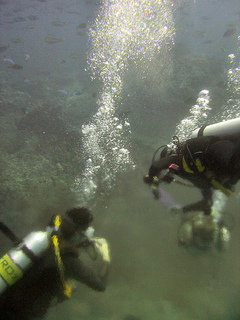
The thermocline is something you get to know soon enough when you're a scuba diver - the effects on the environments are extremely easy to spot : water below you becomes blurry and suddenly temperature drops by a couple degrees, enough to get you a chill. Move up a few centimeters above the blur, the water is hot again. The blur is actually caused by the altered refractive index of the cold or warm water column. This heat barreer is called the thermocline.A definition (by Weatherfacts) would be : The thermocline (gr: thermo = hot and clino = slope) is generally a steep gradient of rapid temperature change, but applied more particularly to a layer, in a body of water, in which the...
Know your gear : the regulator
by Ksso on February 12, 2011

The regulator is a key piece of the diver's gear. Like my instructors used to repeat relentlessly "Air is life", and the regulator bring breathable air to your mouth. The main function of a regulator is fairly simple:
Adjust the air pressure (from the tank pressure to the environment pressure)
Enable inhale and exhale of the air
The classic regulator is composed of 2 stages. The first stage mounts right on the tank and will adapt the tank's air pressure to the environment. Standard 1st stage regulators also include a high-pressure plug to connect to the manometer and get a direct reading to the tank's pressure (and letting you know hom much air you've got left).A 1st stage regulator...
Common hand signals
by Ksso on February 05, 2011
If you haven't been diving for a while, before getting back in a suit it's always a good idea to review the basic hand signals used for communicating underwater.... you know, just in case you need them ( and to make sure you don't thumb-up your dive buddy ... (thumb-up means we're going up now)).There are more gestures than that and you should think while on the boat to reassess those that may be used during the dive to point on the rare fish you may run into.Common Hand Signals for Scuba Diving
Share your experiences, thoughts, or ask a question |
| WRITE A POST |
Latest Questions
Join Diveboard

Categories
Latest Posts
 Help Test The New Diveboard And Raise More Funds!
by Ksso on April 25, 2023 Getting Ready For Diveboard V2 Join Our Discord
by Ksso on September 08, 2021 Scorpion Fish Identification: Stonefish Vs Devil Vs Scorpionfish
by The Smiling Seahorse on February 08, 2021 Best Online Ressource For Fish & Critters Identification
by The Smiling Seahorse on October 05, 2020 Try Out The Beta Android App
by Ksso on August 28, 2020
Older Posts
- April 2023 (1)
- September 2021 (1)
- February 2021 (1)
- October 2020 (1)
- August 2020 (1)
- November 2018 (1)
- June 2017 (1)
- May 2017 (3)
- April 2017 (2)
- March 2017 (1)
- May 2016 (1)
- April 2016 (1)
- February 2016 (1)
- January 2016 (1)
- December 2015 (1)
- November 2015 (2)
- July 2015 (1)
- June 2015 (4)
- May 2015 (2)
- April 2015 (3)
- February 2015 (1)
- January 2015 (2)
- December 2014 (1)
- November 2014 (1)
- October 2014 (5)
- September 2014 (5)
- August 2014 (2)
- July 2014 (2)
- June 2014 (5)
- May 2014 (6)
- April 2014 (5)
- March 2014 (7)
- February 2014 (1)
- January 2014 (5)
- December 2013 (2)
- November 2013 (5)
- October 2013 (2)
- September 2013 (5)
- August 2013 (7)
- July 2013 (7)
- June 2013 (10)
- May 2013 (1)
- April 2013 (3)
- March 2013 (1)
- February 2013 (2)
- January 2013 (5)
- December 2012 (2)
- November 2012 (8)
- September 2012 (1)
- August 2012 (2)
- July 2012 (3)
- June 2012 (1)
- May 2012 (3)
- April 2012 (1)
- March 2012 (7)
- February 2012 (1)
- January 2012 (5)
- December 2011 (3)
- November 2011 (3)
- October 2011 (8)
- September 2011 (3)
- August 2011 (11)
- July 2011 (4)
- June 2011 (8)
- May 2011 (13)
- April 2011 (6)
- March 2011 (10)
- February 2011 (15)
- January 2011 (9)
BCommunity Feed
Community blog posts rRSS feed
 We are participating today in the startup contest Techcrunch Disrupt. Support Diveboard by voting for us!